

The coastline of Begur, in the heart of the Baix Empordà, is one of the most distinctive stretches of the Costa Brava, both for the variety of its landscapes and for the way the sea, the rock formations and the Mediterranean vegetation have shaped a place with real character. Along the coast, small coves sheltered by cliffs alternate with more open beaches, old fishing hamlets and paths that lead to corners which, despite the town’s popularity with visitors, still keep much of their original charm.
Getting to know the beaches and coves of Begur is also a way of getting closer to the town’s history and to the relationship its people have always had with the Mediterranean. Each spot has its own character, from the most accessible sandy beaches to small pebble coves, and offers a different experience depending on the season, the state of the sea or simply how you like to enjoy the coast.
On this journey we will discover some of the most representative places on the Begur coastline, looking beyond their scenic beauty to the surroundings, the ways in and the small details that give each cove an identity of its own.
Sa Riera, a beach open to the Mediterranean
Located in the north of the municipality, Sa Riera is one of the largest beaches in Begur and one of the busiest in summer, thanks to its size, the services on offer and its relatively easy access. Its name comes from the stream (riera) that flows into the sea at this point, where a wide strip of sand meets the wooded hills that surround it.
Although residential and tourist growth has changed the surroundings considerably, Sa Riera keeps some reminders of its seafaring past, especially the old buildings linked to fishing. Today it is a beach particularly popular with families and with those who like to have services close at hand without giving up a truly Mediterranean setting.
One of its highlights is the coastal path (camí de ronda) towards Illa Roja and Platja del Racó, a route that lets you see the coast from different angles and watch the landscape change as you head north.
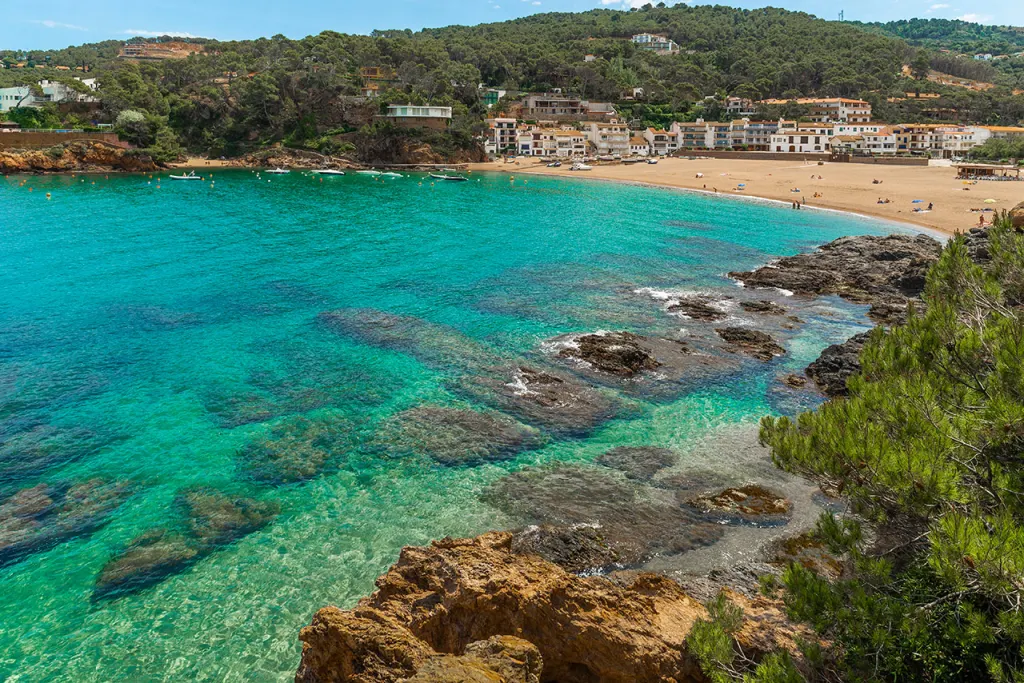
Sa Tuna, Begur’s seafaring heritage
Among the many coves along the Begur coastline, Sa Tuna has kept a character closely tied to the town’s fishing past. The old fishermen’s houses, clustered around a small pebble beach, form an ensemble that has preserved much of its original feel despite the changes the Costa Brava has seen in recent decades.
The layout of the buildings, the nearby hills and the paths along this stretch of coast create a landscape worth discovering slowly, especially outside the peak tourist months. Early in the morning, when there is still little activity, it is easy to see why this little hamlet remains one of the most photographed spots in the municipality.
Sa Tuna is also a good starting point for exploring the area on foot, as the coastal paths lead to other hidden corners and offer views of the sea that are hard to appreciate from the beach itself.

Aiguablava, the landscape that made the Costa Brava famous
Aiguablava beach is probably one of the most recognisable landscapes in Begur, largely thanks to its pale sand and the colour of its water, which in certain light takes on the turquoise tones it is famous for. Set in a fairly sheltered bay surrounded by rocks and greenery, it is a fine example of the variety of landscapes that defines this part of the Costa Brava.
It is on the small side, something worth bearing in mind in high season, when its popularity draws large numbers of visitors. Outside July and August, however, Aiguablava offers a very different experience, especially pleasant for anyone who wants to take in the scenery or stroll around without the summer crowds.
The area is also known for homes built into the coastal landscape, some of which, like many houses with sea views in Begur, enjoy panoramic views over the bay. This dialogue between architecture and landscape is one of the features that have shaped Aiguablava’s residential identity.

Platja Fonda, a cove shaped by its cliffs and geology
Unlike other beaches in the municipality, Platja Fonda is more secluded and still closely tied to the natural features of the coast. Set at the foot of a series of cliffs, it stands out for its dark, coarse sand, which contrasts with the colours of the sea and the vegetation on the nearby slopes.
It is reached by a long, steep staircase, something to consider before you go, especially with small children or anyone with limited mobility. This access, together with the absence of large built-up areas next to the beach, helps preserve an atmosphere quite different from that of the more accessible parts of the coast.
Platja Fonda is especially rewarding for those who love rocky landscapes and the feeling of being in a place where geography still shapes much of the visitor’s experience.
Illa Roja, a unique landscape in northern Begur
Between Sa Riera and Platja del Racó lies Illa Roja, a cove named after the large reddish rock formation that rises next to the sand. This rock, standing out against the blue of the sea and the softer colours of the coast, has made the spot one of the most iconic images of the Begur coastline.
It is usually reached along the coastal path, a walk that lets you appreciate the unusual landscape before you arrive at the beach. Illa Roja is also known for its naturist tradition, part of the identity of the place and worth bearing in mind when planning your visit.
Beyond its popularity, this cove is a good example of how geological features have given names and personality to many corners of the Costa Brava.
Aiguafreda, a small inlet surrounded by nature
A short distance from Sa Tuna lies Aiguafreda, a small rocky cove that offers quite a different experience from the sandy beaches. With an inlet sheltered by rocks and surrounded by Mediterranean vegetation, it is especially popular with those who prefer to swim somewhere more secluded.
A designated area for getting into the water makes swimming easier, although the seabed makes suitable footwear a good idea. When the sea is calm, the clear water lets you see the submerged rock formations and some of the marine life of this coast.
Aiguafreda is not the place for long stretches of sand, but for a closer connection with the coastal landscape, in a setting where rocks and sea take centre stage.
Fornells, a group of small coves with their own identity
The Fornells area, in the south of the Begur coastline, is made up of several small coves and corners that share a landscape of rocks, greenery and clear water. Unlike the larger beaches in the municipality, here the coast breaks up into little inlets that invite you to explore on foot and discover what makes each one special.
The area has close ties to the fishing tradition and to the residential development the Costa Brava saw throughout the twentieth century. The buildings, the narrow paths and the views over the Mediterranean show how the natural landscape and human activity have evolved side by side.
A walk around Fornells is a good way to discover a coastline that is less uniform than it might seem at first glance, where each short stretch offers a different view of the sea and the surrounding hills.
Platja del Racó, open space and views of the Medes Islands
At the northern end of the Begur coastline, Platja del Racó offers a more open landscape than the coves in the south of the municipality. It runs on into Pals beach, forming a long stretch of sand that contrasts with the cliffs and small bays found along much of the Begur coast.
From here you can see the Medes Islands (Illes Medes), part of one of the best-known landscapes on the Empordà coast. The width of the beach makes it ideal for walks by the sea and an appealing alternative for those who prefer open spaces, especially outside the busiest times of year.
The nearby coastal path to Illa Roja and Sa Riera also lets you combine a day at the beach with a walk along one of the most characteristic stretches of the Begur coast.
The coastal paths, another way to discover the coastline
Although the beaches are among the town’s main attractions, one of the best ways to understand Begur’s geography is to walk some of its coastal paths (camins de ronda). These routes, historically used to travel between points along the coast and to keep watch over it, reveal the landscape from angles that cannot always be reached by road.
Along the way, views over the Mediterranean alternate with wooded stretches, steps cut into the rock and small natural viewpoints from which to take in the shape of the land. Some routes link nearby beaches, while others include climbs and sections that call for a reasonable level of fitness.
Before setting out, it is worth checking the condition of the route, the weather forecast and the level of difficulty, as not every path suits everyone or every time of year. With a little planning, however, they are one of the best ways to experience Begur’s natural heritage.
When is the best time to visit Begur’s beaches?
Summer brings most of the town’s tourist activity, especially in July and August, when the best-known beaches can get very busy and access by car is more difficult. So if you are looking for peace and quiet, it is best to arrive early in the morning or consider other times of year.
Spring and early autumn are particularly pleasant for exploring the coast on foot, as temperatures tend to be milder and the coastal paths can be enjoyed without the intense summer heat. In the colder months, the coves show a different side, with far less activity, which brings out the natural, seafaring character of the area.
At any time of year, it is important to follow local guidance, check access conditions and help protect natural spaces that are part of Begur’s landscape heritage.
Begur, a place to discover beyond the holidays
The beaches and coves of Begur explain much of the town’s appeal, but its identity is not limited to the coast. The old town, local traditions, Empordà cuisine and the proximity of other towns in the Baix Empordà make for a setting that remains just as interesting beyond the summer months.
This combination of heritage, nature and quality of life has caught the attention of people who, having discovered Begur on holiday, are thinking of buying a second home or moving here for good. The different areas of the municipality offer very different options, from homes in the historic centre to houses on residential estates and in the areas closest to the sea.
Many of the coves on this route are surrounded by residential areas with a character of their own. If one of them has caught your eye, take a look at the houses for sale in Sa Riera, Sa Tuna, Aiguablava, Aiguafreda or Fornells.
Knowing the particular features of each area is especially important when considering buying a house in Begur, as factors such as access, proximity to services, orientation or tourist activity can make a big difference to what it is like to live there.
At Promobegur, an estate agency specialising in buying and selling property in Begur and the Baix Empordà since 1985, we know these differences first-hand and how each part of the municipality has evolved. Led by Marià Renart Carreras, a licensed estate agent (Agent de la Propietat Immobiliària), we offer personal advice to anyone wishing to buy or sell a property on the Costa Brava, based on experience, direct contact and in-depth knowledge of the local market.
If you are thinking of buying a house, an apartment or a plot of land in Begur, we invite you to browse our selection of properties for sale in Begur and on the Costa Brava and to get in touch with us for friendly, professional advice.


